AI ideas are abundant; attention is not. Every week brings another tool, headline, and vendor pitch. A useful filter starts with the repeated work, the risk, and a measurable business result—not the novelty of the demo.
The goal is not to keep up with AI. It is to make a better decision about one possible use.
Useful AI connects to a measurable result
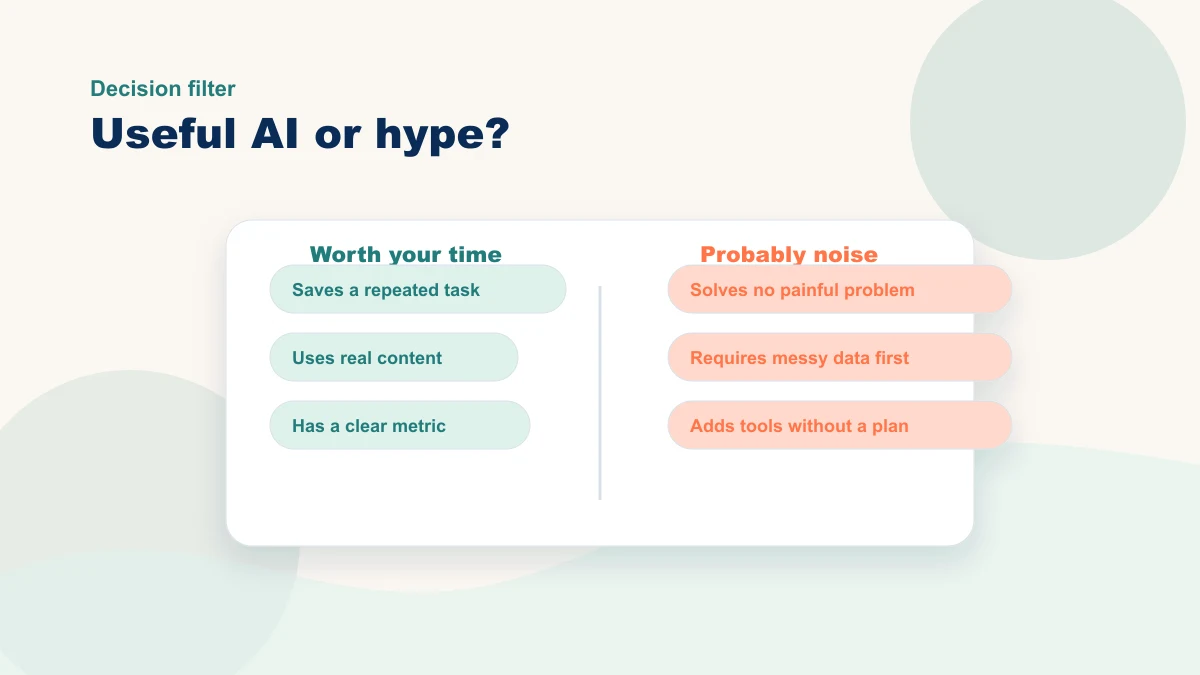
If a tool promises transformation, start by asking which workflow improves first. Useful AI should connect to something concrete: response time, content throughput, lead quality, repeat purchase rate, support resolution time, or hours saved.
Real improvement is specific enough to measure and simple enough for the team to understand. If you cannot name the metric and reviewer, you are not ready to pick a tool.
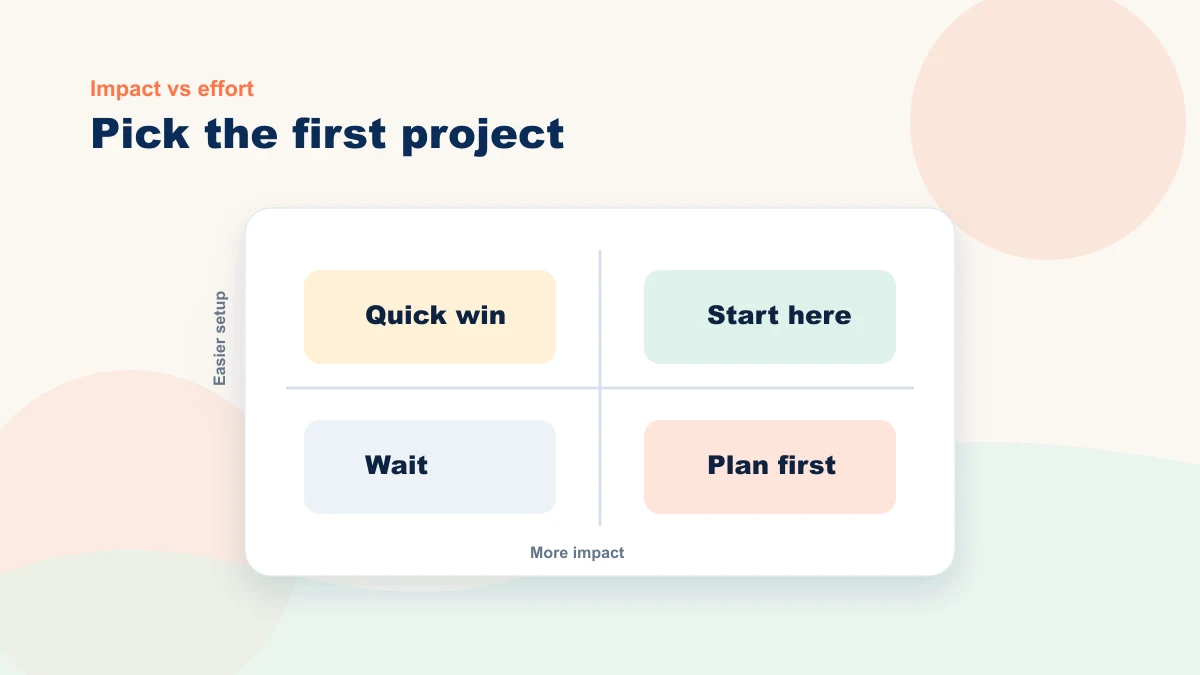
If you are still deciding which result should come first, use the first-project filter before comparing vendors. It keeps the conversation tied to work your team already feels.
Prioritize tools that fit your current workflow
Prefer a bounded improvement you can reverse over an all-at-once replacement. Test value before you overhaul the website, migrate data, rewrite a process, or retrain the team.
Start with one part of a system you already own: a site, form, email flow, support source, or content calendar. The existing asset supplies the facts and the baseline.
Look past the polished demo
Demos are supposed to look good. The better question is whether the tool works with your real policies, edge cases, and customer expectations. This is the part vendors rarely show, and it is the part that decides whether AI helps or hurts your business.
| Looks impressive | Actually matters |
|---|---|
| Fast, polished replies | Accurate replies tied to your real content and escalation path |
| Fancy dashboards | Clear signals your team can act on |
| Automation everywhere | Automation in the one workflow costing you time today |
Include privacy and brand quality early
Strong AI advice treats automation, privacy, quality, and tone as part of the same decision. If customer data is involved, privacy matters. If public-facing content is involved, quality matters. If the system affects trust, tone matters.
Include privacy, accuracy, voice, and escalation in the first workflow map. Discovering those requirements after launch creates avoidable rework and risk.
For customer data, use the privacy and GDPR guide before connecting tools to forms, CRMs, or support inboxes. For public-facing copy, build the guardrails in the brand voice guide before publishing AI-assisted content.
The right AI strategy is the one that improves a real outcome while protecting trust.
A simpler filter for every AI idea
Before you adopt a tool, ask five questions:
- What workflow does this improve?
- How will we know it worked?
- What content or data does it rely on?
- What could go wrong for privacy, accuracy, or tone?
- Can we test it without changing everything else?
If you cannot answer those questions clearly, wait. If you can, you have something worth exploring.
Where prioritization gets stuck
The hard part is prioritization. With a dozen ideas competing for attention, a team can freeze or chase the loudest one. Compare each idea against the same five questions above and preserve the reasons for the decision.
A workflow review applies that filter to one real idea and ends with a clear test, a prerequisite to fix, or a reason to wait.