A small business can postpone documentation while the same people perform the work. The gap becomes visible when someone is absent, a new hire joins, or one person is the only source for a critical process.
An SOP does not have to be a corporate manual. It can be short, clear, and practical. AI can prepare a structured draft from a walkthrough, transcript, or notes; the person who knows the work still verifies every step and exception.
Why documentation keeps getting postponed
The reason is not laziness. It is that writing SOPs feels like another project on top of your actual work. You have a client due date or a product issue, and documenting the process feels like a luxury you cannot afford right now.
Without a shared procedure, training, handoffs, and coverage depend on memory. An SOP will not solve every people or process problem, but it gives the team one version to test, correct, and improve.
You can record the task, describe it, or supply messy notes, then ask AI to prepare a structured draft. Choose the process first, remove sensitive data from the input where appropriate, and have the process owner verify sequence, access, safety, exceptions, and completion checks.
A short SOP the team tests and updates is more useful than a polished document nobody follows.
A four-part SOP structure to test
A useful starting structure has four parts. AI may organize the draft, but the capture and review time depends on the process, its risks, and its unwritten exceptions:
- Purpose and overview. What is this process for? When does someone do it? Why does it matter?
- Before you start (prerequisites). What do you need? What tools? What access? What other steps need to be done first?
- The steps (numbered, clear, short). This is the meat of the SOP. Each step is one action. Not three steps squeezed into one instruction.
- After it is done (checklist or handoff). How do you know you did it right? What happens next? Who needs to know?
From Messy Notes to a Real SOP
Here is the real-world process. You have been doing a task for three years. You know every corner and exception. You also have not written it down because it is in your head. Now you need to give it to someone else.
You can write from a blank page, or give AI a walkthrough and use the output as a draft. Measure the total capture and review effort; the time depends on the process complexity and missing exceptions.
With participant permission, you can record a walkthrough and supply an approved transcript to AI as draft input. Ask it to propose numbered steps and mark ambiguities; the process owner still checks access, safety, sequence, exceptions, and completion criteria.
The draft may miss a detail or misunderstand a rushed explanation. Treat it as a starting point the process owner and a less-experienced tester must walk through before anyone relies on it.
Before and After Example
Messy notes from an owner: "Okay so when we get a new client, we need their details. Ask them about their budget, timelines, the main issue. Then we scope out the project. Send them an email with what we think it should cost and how long. Then they approve or we negotiate. After that we make a contract with the terms. Then we get them set up in our system and the first touchpoint is scheduled."
Illustrative AI-prepared SOP draft:
Client Onboarding Process
Purpose: To gather client information, establish project scope, and prepare for delivery.
Prerequisites: Access to client intake form, email templates, project management system, contract template.
Steps:
1. Receive new client inquiry or signed agreement for engagement.
2. Send client our intake questionnaire requesting: business context, project goals, timeline expectations, and budget range.
3. Collect completed form within 48 hours.
4. Meet with client (or review detailed responses) to define project scope and deliverables.
5. Create initial project estimate: scope, timeline, and fee.
6. Send scope document and estimate to client for approval.
7. Upon approval, prepare and send service agreement for signature.
8. Create project in management system and assign team members.
9. Schedule and send first meeting details to client.
10. Log onboarding completion and send welcome email to client.
This example shows the structure, not a promised completion time. A real SOP still needs a process owner to verify every step and a second person to test it without relying on unwritten knowledge.
Stuck on which process to document first? Compare tasks by frequency, risk, process-owner availability, exception load, and the cost of inconsistency. Bring the top two to a free 15-minute bottleneck review and choose one testable SOP candidate. Book a free bottleneck review.
Keeping SOPs Alive
A documented failure mode is letting an SOP go stale. Tools, policies, owners, risks, and common exceptions change; the document needs an owner, review trigger, version date, and correction path.
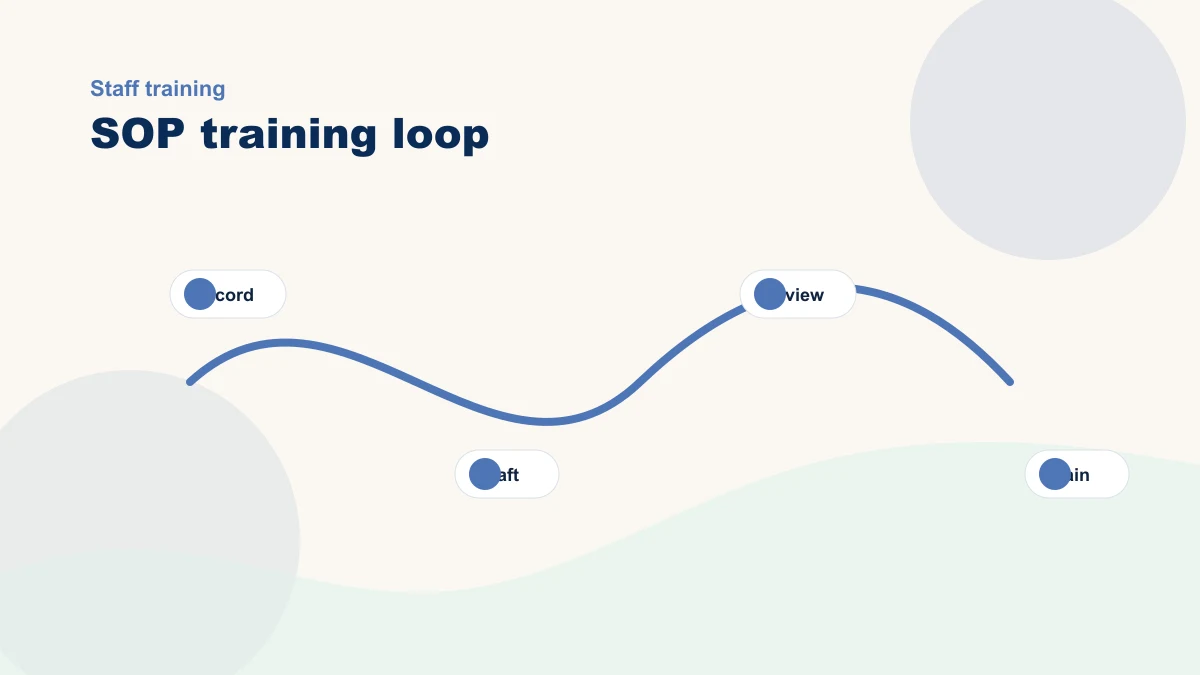
Choose a review cadence and event triggers that fit the process risk. Recheck after tool, policy, staffing, safety, or workflow changes; ask the team where reality differs, correct the source, and date the update. AI may prepare a revision diff for the process owner to approve.
Prepare training assets from the approved SOP
Once the process owner approves the SOP, AI may prepare a checklist, scenario questions, training email, or refresher draft from that source. A qualified reviewer verifies answers, permissions, safety, accessibility, and whether the asset reflects real exceptions.
Once the process owner approves it, the SOP becomes the source for checklists, training drafts, and updates. Measure whether it reduces repeat explanations, missed steps, and correction work during real onboarding.
| Training asset | AI can draft | Owner should review |
|---|---|---|
| New-hire checklist | Steps to complete before working independently | Which steps require manager sign-off |
| Knowledge check | Five scenario questions based on the SOP | Whether the right answers match real exceptions |
| Refresher email | A short reminder of the most missed steps | Tone, timing, and whether the issue is process or training |
Where to Go From Here
You can absolutely do this on your own — and if you have the time and patience to figure out the right prompts, the right level of detail, and the right starting point, you should. If you want guided help, the engagement can turn one observed process into a review-ready SOP, test it with the process owner, and document which process should be considered next.
We start with one repeated process and the person who knows it. If you are still choosing the candidate, use the admin audit to find work that is frequent, consequential, hard to transfer, and possible to observe. The deliverable is a reviewed SOP draft, a test record, and explicit next questions. See how we work together or book a free 15-minute bottleneck review when you are ready.