If content creation keeps falling to the bottom of your list, the bottleneck may be the repeated decisions around topic, proof, format, and review. AI can prepare several drafts from one approved idea, but a person still supplies the facts, chooses the angle, and decides what is publishable.
Use the 30-minute sequence below as a working session, not a guaranteed production time. Record how long your own source, draft, fact-check, voice edit, and approval steps take. Pair it with the AI SEO planning process or the marketing prompt examples when those inputs need work.
Minute 1 to 5: choose one business topic
Start with something customers actually care about: a seasonal service, a common objection, a product category, a frequent question, or a recent client win. One good topic beats ten random ideas. If you are not sure which topics support the offer, check customer questions, search data, sales conversations, and existing page results before drafting.
Minute 6 to 10: build the core brief
Ask AI to create a simple brief: target audience, key message, common questions, proof points to mention, and a clear next step. The quality of this brief is what separates content that sounds like everyone else from content that sounds like you. Skipping this step leaves the model to fill gaps with generic language.
| Brief field | What to write before using AI | Why it matters |
|---|---|---|
| Audience | Who the content is for and what they already believe | Prevents generic advice |
| Proof | One story, result, policy, or example only your business can provide | Makes the final content credible |
| Next step | The action the reader should take after consuming the piece | Keeps the output tied to revenue or retention |
Minute 11 to 18: expand into formats
From that brief, ask AI to generate:
- One short email
- Three social post drafts
- One blog outline or service-page section
- One call-to-action variation
If you want this tuned to your business, bring one approved topic, your offer, and two examples of your voice to a free 15-minute bottleneck review. We will map the source, draft formats, review pass, and first metric.
Minute 19 to 25: edit for brand and specifics
This is where the draft becomes publishable. Add the real example, the local reference, the actual offer, the customer language, and the tone your audience expects. AI speeds up the draft. You (or someone who knows your business) makes it worth publishing. If your team does not have the time or writing confidence to handle this pass consistently, a written brand voice guide can give each draft an explicit review standard. The guardrails in How to Use AI While Protecting Your Brand Voice are the natural companion to this editing pass.
Minute 26 to 30: schedule and reuse
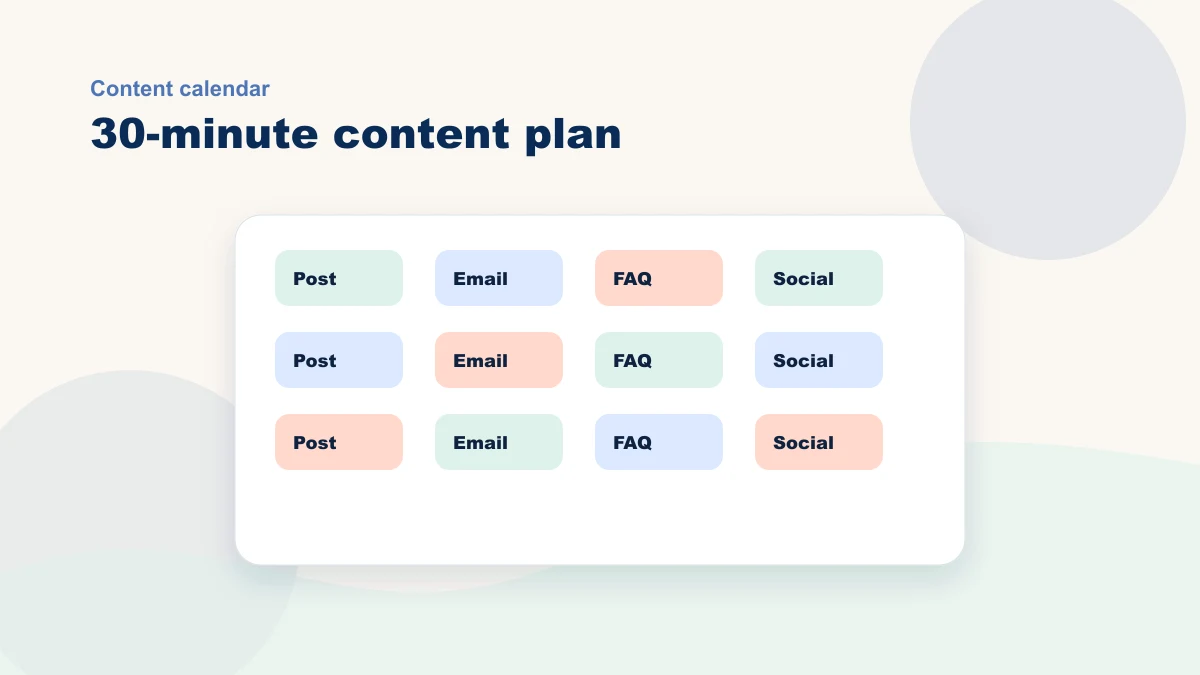
Put the assets into your calendar, queue the email, and note how the same idea could become a FAQ, a landing-page update, or a follow-up sequence later. A documented reuse step keeps one source from becoming a one-off. One properly briefed topic can support several reviewed assets without inventing new proof.
Measure the full source-to-review cycle. A faster first draft is not useful if correction work expands.
A quick QA checklist before you publish
- Does every piece point to the same offer or next step?
- Did you add one real example, customer phrase, or local detail?
- Does the tone match how your business talks on the phone?
- Can the same idea support a future FAQ, email, or service-page update?
That is the bounded sequence: one topic, one brief, several draft formats, and one human review pass. Treat 30 minutes as the working-session structure, then record your real total time and correction rate. If you want help adapting the sequence, bring one source and one finished example to a workflow review.