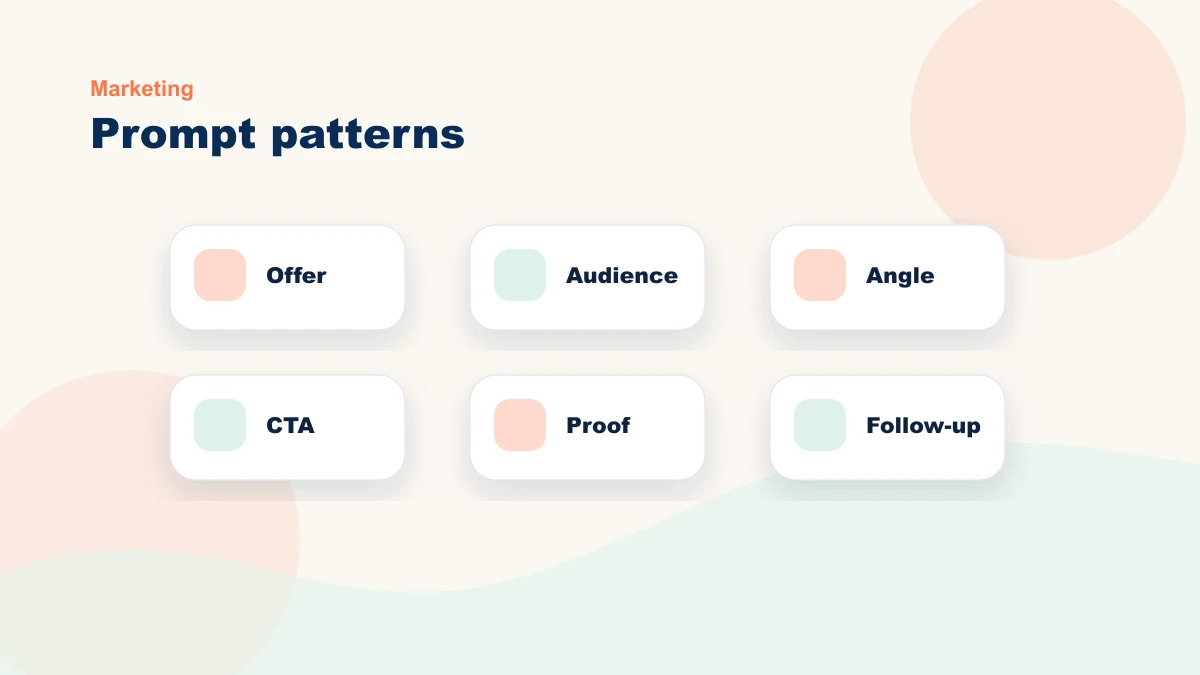
Vague prompts produce generic marketing because the tool has to guess the role, audience, goal, context, and format. The six patterns below supply those five inputs so the first draft has a defined job.
Use them as starting structures. Add a real offer, approved proof, customer language, a voice example, and a human review step before anything is published or sent.
A simple prompt formula
Start with this reusable structure, then swap in the details for your offer, audience, and campaign.
- Act as: [role]
- For: [audience]
- Goal: [goal]
- Context: [context]
- Deliver as: [format]
The hidden ingredient is context. Before you ask AI to write anything public, paste in the offer, the audience, the page or email it will live in, and one or two examples of messages that already sound like you. If your business is still choosing where AI should fit first, pair these prompts with The Best First AI Project for a Small Business so you use them inside a useful workflow instead of as one-off experiments.
| Weak prompt | Stronger prompt | Why it works better |
|---|---|---|
| Write a post about our HVAC tune-up. | Act as a local service marketer. Write a 140-word Facebook post for homeowners who delay maintenance until something breaks. Goal: book spring tune-ups. Tone: calm, practical, neighborly. | It gives the AI a buyer, timing, pain point, channel, goal, and tone. |
| Improve this offer. | Review this offer for a time-starved small business owner. Suggest three clearer value propositions, one risk-reversal line, and two CTA options that do not sound pushy. | It asks for useful parts you can judge instead of a vague rewrite. |
| Give me blog ideas. | Using these five customer questions, suggest 10 blog topics for owners comparing DIY AI tools with consulting help. Include search intent, promise, and one internal link idea for each topic. | It turns customer language into a structured content plan. |
1. Email subject line prompt
Prompt: Act as a direct-response email strategist for a local service business. Create 10 subject line options for a spring maintenance reminder. The tone should be clear, helpful, and not gimmicky.
For the spring maintenance reminder prompt, a useful first pass might look like this:
- Book Your Spring Tune-Up Before the Busy Season Starts
- A Quick Spring Check Now Can Prevent Costly Repairs Later
- Spring Maintenance Reminder for Homeowners Who Want Fewer Surprises
The output is a set of candidates, not a winner. Compare them with your past email results, remove claims you cannot support, and test only the options that still sound like your business.
2. Service page angle prompt
Prompt: Act as a conversion-focused copywriter. Suggest five headline angles for a roofing estimate page aimed at homeowners who care about speed, trust, and financing options.
Generating headline angles is easier than choosing the one supported by the audience, offer, price, proof, traffic source, and page goal. Keep that choice with a person who knows the business.
A good next step is to ask for the tradeoffs: "Which angle is strongest for a visitor who found us through Google? Which is strongest for a referral who already trusts us?" That turns a pile of options into a decision. If the page is meant to bring in organic traffic, connect this prompt to the briefing process in How AI Can Make SEO Planning Easier for Small Businesses so the headline supports the search intent instead of floating on its own.
3. Social repurposing prompt
Prompt: Turn this blog outline into three LinkedIn posts, two Instagram captions, and one short email teaser. Keep the tone plain and practical.
A bounded repurposing test starts with one approved outline and prepares several channel drafts for review, as shown in A 30-Minute AI Workflow for a Week of Content Drafts.
If repurposing repeats every week, inspect the source brief, approved proof, destination formats, reviewer, and publishing handoff before adding prompts. Bring one source and one finished example to a free bottleneck review.
4. FAQ generation prompt
Prompt: Based on this service description and these de-identified, approved customer-question excerpts, propose 12 FAQ candidates. Cite the source excerpt for each, mark unsupported gaps, and draft concise first-pass answers for review.
FAQs can be a useful first project because the source is close at hand: sales calls, support messages, and service conversations. Use the prompt to identify candidate questions, then verify them against real records before publishing.
Do not stop at the first list. Ask the AI to separate buying questions from support questions, then ask which answers should live on a service page, quote form, chatbot, or follow-up email. That small sorting step keeps your website cleaner and gives your customer service workflow better source material. For a deeper version of that handoff, read How Small Businesses Can Use AI for Customer Service.
5. Offer refinement prompt
Prompt: Review this current offer and suggest three stronger positioning angles for time-starved small business owners who want clear, practical AI guidance.
Before asking AI to vary the wording, define the permitted outcome, proof, audience, and next step on the services page. An outside review can help when several offers, audiences, or objections compete for priority.
6. Content brief prompt
Prompt: Create a blog brief for the topic "AI for small business customer support." Include audience intent, key subtopics, FAQ ideas, internal links, and a call to action.
For search-driven briefs, pair this with How AI Can Make SEO Planning Easier for Small Businesses so the outline connects to real customer questions and useful internal links.
Too vague: "Write a social post about our business."
Better: "Act as a local service marketer. Write a LinkedIn post for homeowners deciding whether to repair or replace an aging roof. Goal: book estimate calls. Tone: calm, practical, trustworthy. Format: 150 words plus CTA."
Common mistakes that make prompts underperform
- Asking for finished copy too soon. Use AI for angles, outlines, objections, and options before asking for a polished draft.
- Leaving out the source material. Paste in the offer, customer questions, service page, or prior email so the answer is grounded in your business.
- Using one prompt for every channel. A service page, referral email, Google Business Profile post, and Instagram caption need different formats.
- Skipping the brand voice pass. Run a second prompt that asks AI to make the draft sound more like your real business. The system in How to Use AI While Protecting Your Brand Voice is built for that step.
- Measuring output instead of outcome. Faster drafts only matter if they help you publish consistently, answer buyer questions, or generate better leads.
FAQ: using AI prompts for small business marketing
Should I use the same prompt every week?
Use the same structure, not the same details. Keep the role, audience, goal, context, and format, then refresh the customer question, offer, seasonal angle, or channel every time.
How much should I edit AI marketing copy?
Enough that a reviewer can compare the draft with approved examples. Use AI to prepare the first pass, not to replace judgment about claims, tone, proof, pricing, or customer fit.
What is the best prompt to start with?
Start with FAQ generation if your website feels thin, service page angles if your offer is unclear, or social repurposing if consistency is the problem. The best prompt is the one tied to a workflow you will repeat.
Can these prompts help with lead generation?
Yes, especially when they sharpen the message before a visitor fills out a form or replies to an email. For the next step after the message is written, see AI for Lead Follow-Up: Fix the Handoff Before Buying More Traffic.
Where prompt use breaks down
Prompts are only one part of the workflow. The harder decisions are which task deserves a prompt, what approved context it needs, who reviews the output, and how the usable result enters the marketing calendar.
A workflow review starts with what you already have, compares repeated marketing tasks, and builds a small prompt set around one testable handoff. The source, voice rules, reviewer, and metric come before another tool.
Use these six prompts as starting drafts, then add your tone, proof, offer, and review standard. If you want a tailored version, bring one recurring marketing task to a free 15-minute bottleneck review and map the full handoff.