A stack can grow without changing the work: a chat subscription, a plugin, an image tool, and another dashboard renew each month while the same task still gets rebuilt by hand.
A roadmap asks what each tool is supposed to improve: which workflow, bottleneck, handoff, or error. It sequences one bounded test at a time so evidence—not novelty—sets up the next decision.
Why Ad-Hoc AI Fails
Adopting AI without a roadmap is like adding rooms to a house without a blueprint. You patch things when they break, you bolt on features when someone asks, and a year in you cannot tell what is connected to what.
Ad-hoc adoption often creates a recognizable pattern:
- Tools that do not talk to each other, so the team copies and pastes between tabs
- Hours spent learning software that has nothing to do with the real bottleneck
- No way to tell whether AI is saving time or just adding more screens to check
- Team members who tried it once, got confused, and quietly went back to the old way
- Six or seven small subscriptions nobody remembers signing up for
A roadmap solves this because it forces you to start with one workflow, measure the result, and only then pick the next workflow. You stop buying tools. You start solving problems in order.
The Three-Horizon Model
Use three horizons as decision gates rather than fixed promises:
Horizon One: Bounded Test. Choose one frequent, low-risk workflow with a reliable input, named reviewer, and baseline. The point is evidence: did the full process become faster, more consistent, or easier without increasing errors?
Horizon Two: Supporting Workflow. Add a second project only when the first is stable and the connection is useful. If Horizon One prepares lead replies, Horizon Two might prepare approved follow-up content for the same inquiry categories.
Horizon Three: Durable System. Connect workflows only after ownership, data access, exceptions, and measurements are clear. Each connection creates value and a new failure path, so both need review.
The calendar depends on workflow volume, risk, integration work, and how quickly the team can observe enough real cases. Do not advance a horizon merely because a date arrived.
| Horizon | Good example | Proof it is working |
|---|---|---|
| One | Lead reply drafts for common inquiry types | First response time drops and replies stay accurate |
| Two | Follow-up content for the same lead categories | More useful follow-ups go out without more owner time |
| Three | Lead source, reply template, and CRM note work together | The team can see where each inquiry stands without extra chasing |
The 90-Day Rhythm
A modest plan executed in order beats a long tool list with no order to it.
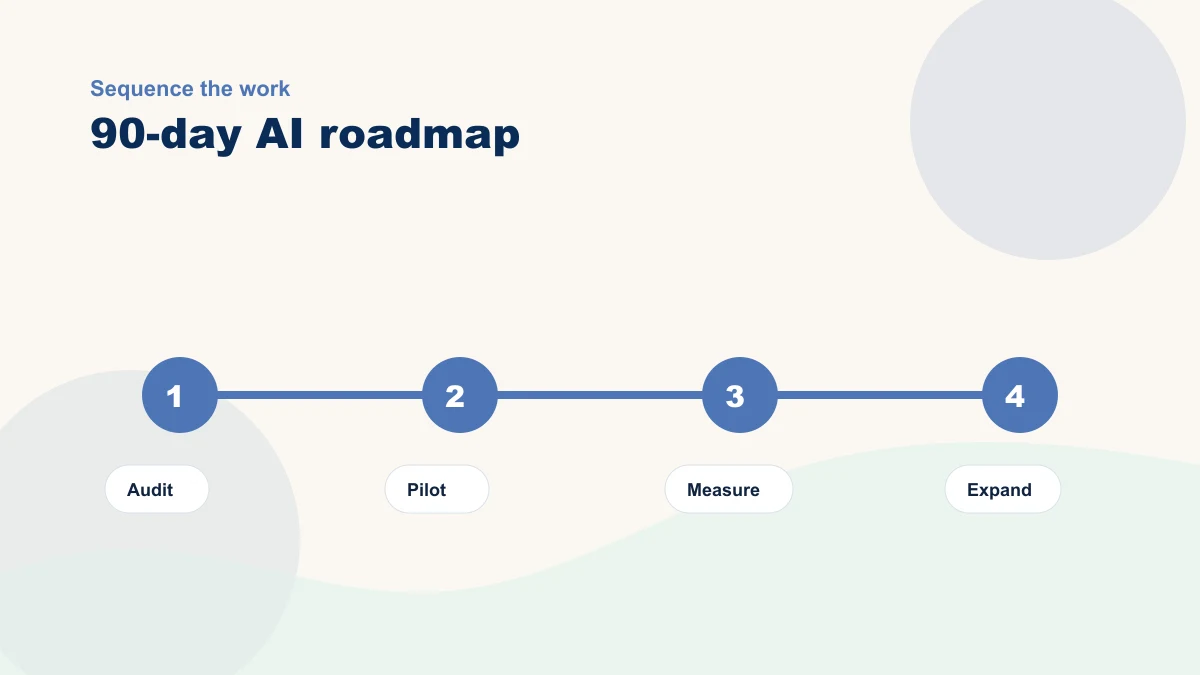
A 90-day planning window can hold one primary decision instead of several competing rollouts. For example: test a reviewed lead-response workflow against response time and correction rate, or test content adaptation against total preparation time and usable output.
Every 30 days, check whether the project is still on track. Every 60 days, decide what Horizon Two looks like. Every 90 days, review what worked, what did not, and plan the next quarter.
Use recurring reviews to keep the test visible, but let evidence set the duration. A high-volume task may reveal a pattern quickly; a monthly task needs a longer observation window.
How to Measure Each Phase
Horizon One: Workload. Did the full task—including review and exceptions—take less time without lowering quality? If the pre-set threshold is met, check cost, risk, and adoption before expanding.
Horizon Two: Quality and volume. Are follow-ups going out faster and to more leads? Is your content reaching more channels with the same effort? The exact metric depends on the workflow—but it should be a number you can read in under a minute.
Horizon Three: System efficiency. Are multiple workflows talking to each other? Did connecting them save time compared to running each in isolation?
Keep it simple. One metric per horizon is plenty. A long metric list can hide the decision the test is supposed to support. If you need a practical way to choose that metric, use the AI ROI measurement guide before you add another tool.
If your Horizon One candidate is still fuzzy, step back to the first-project scorecard. A roadmap only works when the first piece is small enough to finish.
Common Mistakes to Avoid
Do not expect a tool list to create its own sequence. Map the problem, prerequisites, owner, risk, and decision metric before buying software. Introduce one supervised workflow at a time so adoption and correction work remain observable.
Do not confuse polish with readiness. A first test needs a functional handoff, named reviewer, stop conditions, and measurement; evidence from that test determines whether refinement belongs in a later horizon.
When It Helps to Bring in an Outside Set of Eyes
You can absolutely build this roadmap yourself. If you have the time, the pattern-recognition, and the willingness to throw out projects that are not working, go build it. This article is the framework I use—it is not a secret.
Three planning risks deserve an explicit check: a first project chosen for novelty instead of evidence, a second workflow disconnected from the first, and a roadmap that changes whenever a new tool appears.
An outside review is useful when candidates compete for attention, dependencies are hidden, or nobody owns the measurement. The deliverable is a sequence with reasons, risks, reviewers, and decision gates—not a guarantee that experimentation disappears.
Where to Start
If you are doing this on your own, start with the first-project criteria, then use the workflow-first strategy to avoid tool collecting. Pick one workflow and measure it over enough real repetitions for its volume and risk.
If you would rather have a roadmap built with you—tailored to your actual workflows, your team, and the next 90 days specifically—have a look at how I work with small businesses or book a free bottleneck review and we can sketch the first horizon together on the spot.