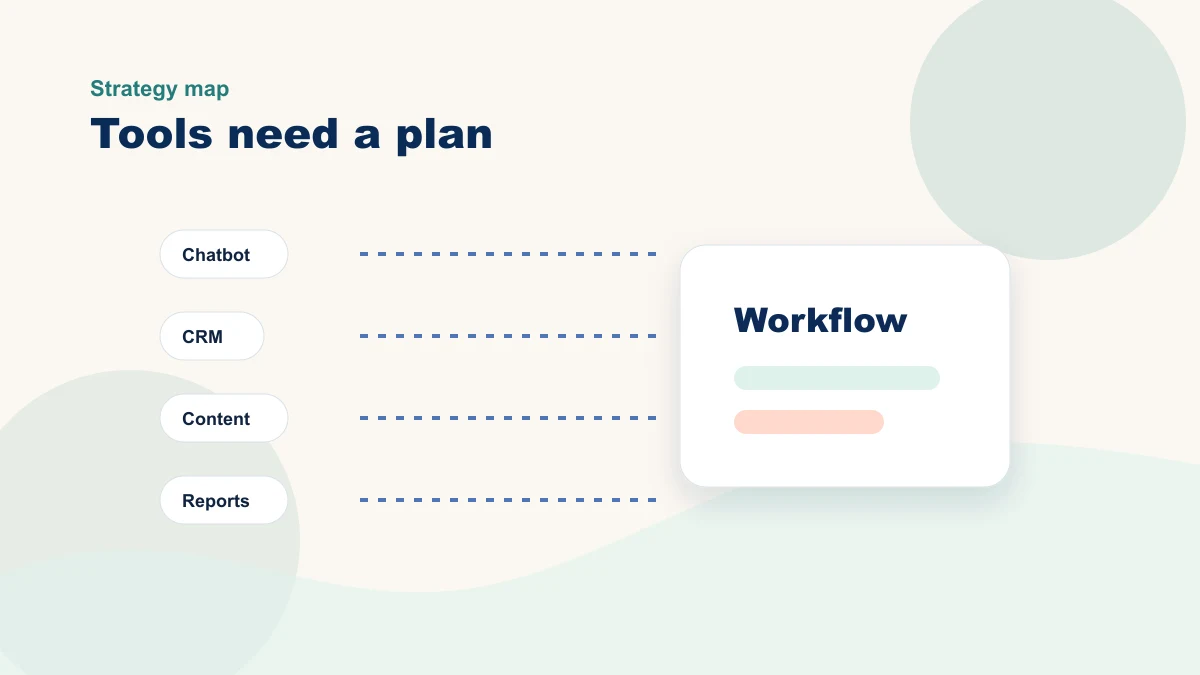
A tool stack can grow one demo at a time: a chat assistant, chatbot, content generator, image tool, scheduling plugin, and summary app. If none has a defined workflow, owner, or metric, the collection is not yet an operating system.
A strategy begins with the work: What outcome should improve, what may AI prepare, what remains human, and how will we decide whether to keep it?
The Tool Collector Problem
Tool collecting happens when you read an article about the latest AI product or see a slick demo and think, "That would be cool to have." You sign up, poke around for a few minutes, then move on to the next shiny thing.
Unused subscriptions are visible evidence that a tool was selected before its workflow. List what each tool does, who uses it, what source it needs, and which metric it should improve.
A tool-first failure pattern is easy to recognize: sign up before naming the workflow, try the tool without an owner or baseline, then stop using it because no operating process changed.
A strategy tells you which outcomes matter and which tools serve them. Everything else is noise.
The fix is to connect each retained tool to one real workflow, human owner, review checkpoint, and decision metric.
What a Strategy Actually Answers
A practical AI strategy answers four questions before software enters the discussion:
- What gets faster? Which workflows will AI speed up? Lead response, content creation, customer service, something else?
- What gets better? Which processes will AI improve? Accuracy, consistency, depth, creativity?
- What gets cheaper? Where does time savings turn into money saved? Often in admin, support, or repetitive content work.
- How will we know it worked? What metric will show that the project succeeded? Time saved, volume increased, cost reduced?
If you cannot answer those four questions about a tool before you buy it, don't buy it. That tool is not part of your strategy — it's just another subscription. For the measurement side, use the AI ROI guide for small businesses to define what should move in the first 30 days.
Tool Stack vs Strategy: The Comparison
Compare a tool-first approach with a workflow-first plan:
| Tool Stack (No Strategy) | Strategy-Driven (With Plan) |
|---|---|
| Five subscriptions, unclear why | Two tools, each solving a specific workflow |
| Tools do not talk to each other | Second tool feeds output of first tool |
| No one on team knows how to use them | One person trained, teaching others gradually |
| No measurement of impact | Time saved tracked for 30 days, then ongoing |
| Abandoned after two weeks | Used consistently as part of workflow |
| Cost is tracked, but value is assumed | Setup, operating cost, review time, and measured result are compared |
The workflow-first approach does not begin with more tools. It begins by naming the repeated task, source, human decision, risk, and metric. An outside review can help when those candidates or dependencies are hard to compare.
Three Examples of Tool-Heavy vs. Strategy-Driven AI
The difference is easiest to see in real workflows:
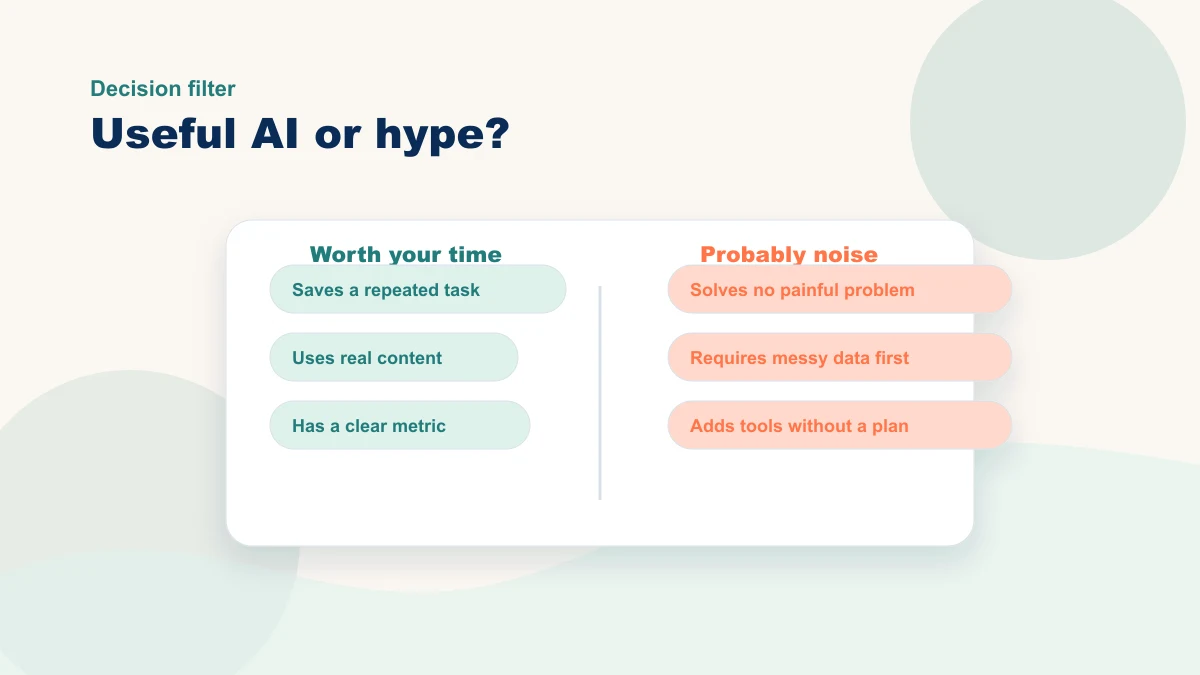
- Lead response: Tool-heavy means buying a chatbot, email assistant, and CRM add-on at once. Strategy-driven means mapping the inquiry types first, drafting three reply templates, and measuring response time for 30 days.
- Content creation: Tool-heavy means subscribing to three writing platforms. Strategy-driven means building one repeatable brief, one voice guide, and one publishing rhythm. The prompt examples in AI Prompts for Small Business Marketing are useful only after that rhythm exists.
- Customer support: Tool-heavy means launching a chatbot before the FAQ is accurate. Strategy-driven means cleaning the source content, defining escalation rules, and then deciding whether an AI chatbot belongs on the site.
How to Convert a Tool List Into a Plan
If you already have tools but no strategy, here is the same process I walk clients through:
First, list the tools you already have. Do not buy a new one yet. Mark which workflow each tool supports, who owns it, and whether the team actually uses it.
Second, for each tool, write down one workflow it supports. If you cannot name one, investigate actual use, contract terms, exports, dependencies, and cancellation before deciding whether to keep it.
Third, pick the one that solves your biggest current bottleneck. That's the tool to focus on first. (If you can't tell which bottleneck is biggest, that's a sign you need a fresh set of eyes on the operation.)
Fourth, choose an observation window that fits the task volume. Measure the full cycle, correction work, and usable completion rate. Expand only if the result clears the threshold you set before the test.
Fifth, when you are ready for a second tool, choose one that connects to the first. If your first tool is draft writing, your second might be editing or fact-checking. Connect them only when the handoff removes a measured gap without obscuring review or adding unnecessary correction work. This is the same sequencing logic behind a practical 90-day AI roadmap.
This approach turns a tool collection into a testable strategy: fewer assumptions, clearer ownership, and an explicit reason to keep, connect, or cancel each tool.
The Right Starting Question
Replace "Which AI tools should we use?" with "Which workflow and decision are we trying to improve?" Tool availability will keep changing; the workflow criteria should remain visible.
Start instead with: "What does our team spend the most time on that feels like it should be faster?" Or: "What workflow do we do repeatedly, and where do we make the most mistakes?"
Answer those, and the tools become obvious. Sometimes it's ChatGPT. Sometimes it's a custom solution. Sometimes it's not AI at all. But your tool choice comes from the problem, not the other way around.
That is a strategy. Everything else is shopping.
If you want an outside review, I can inventory the current tools, compare workflow candidates, and document what to keep, test, connect, fix first, or stop. You can see how the engagements work, read about the 90-day roadmap approach, or book a free 15-minute bottleneck review and we'll sort through your stack together.