A small business does not need a complicated AI budget to begin. It needs a clear answer to one question: is this workflow actually helping?
That question gets fuzzy fast. A tool can feel impressive without saving time. A chatbot can answer a lot of messages without improving customer experience. A writing workflow can create more content while still leaving the owner buried in editing. If you do not measure the right thing, AI starts looking productive while the business stays exactly as busy as before.
You can evaluate a first project with one workflow, a baseline, full setup and operating costs, quality measures, and a review window long enough to observe real use.
Start with one workflow, not the whole business
AI ROI gets messy when you try to measure the entire business at once. Do not ask, "Is AI worth it?" Ask, "Is this lead reply workflow worth it?" or "Is this admin summary worth it?"
That smaller question is easier to answer because you can compare before and after. If you are still choosing the project, use the first AI project scorecard first. ROI measurement works best when the workflow is narrow enough to finish and repeat.
Measure one workflow over enough supervised repetitions before judging AI as a whole. Let task volume and risk set the observation window.
Before you turn on a tool, write down the current version of the workflow:
- How often does the task happen?
- How long does it take each time?
- Who does the work now?
- What does the current process cost in tools, labor, missed opportunities, or owner attention?
- What would a better result look like?
That is your baseline. Without it, every AI project becomes a feeling. With it, you can make a business decision.
The simple AI ROI formula
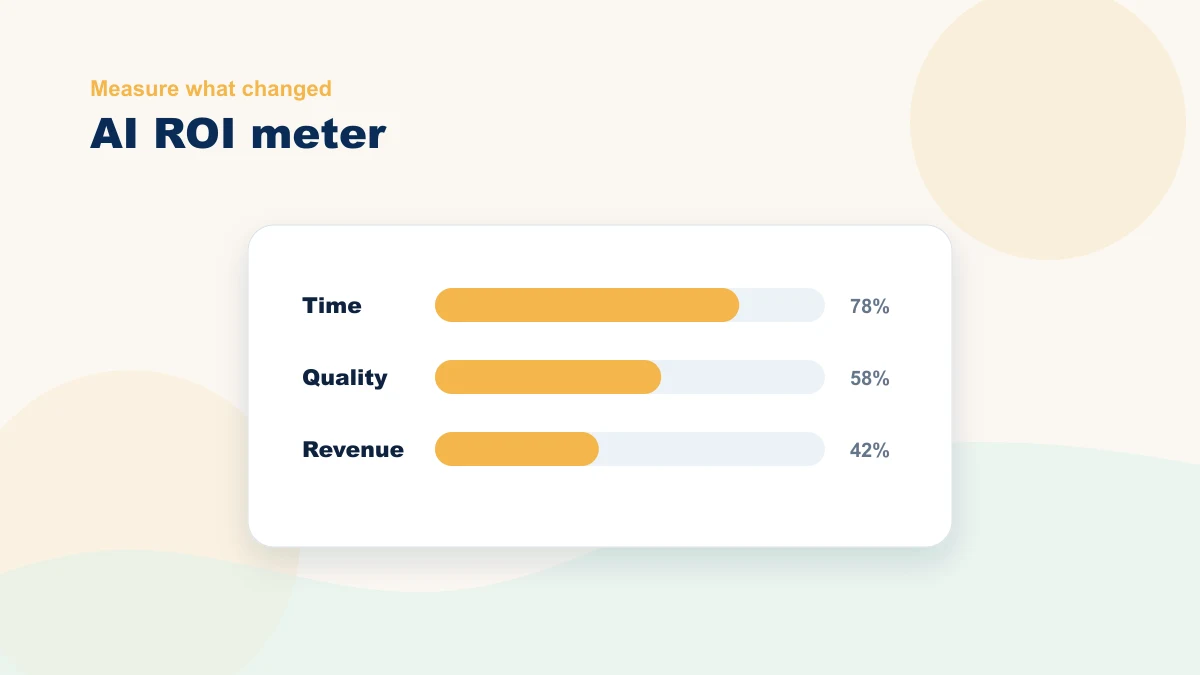
A practical workflow-level ROI review can examine four categories: time, revenue, avoided cost, and quality. Choose the category tied to the decision you need to make and record its baseline before the test.
| ROI source | Plain-English question | Example metric |
|---|---|---|
| Time saved | Are we spending fewer hours on the same work? | Owner hours saved per month |
| Revenue gained | Are more leads, carts, or customers moving forward? | Booked calls, quote requests, recovered carts |
| Cost avoided | Did we avoid hiring, outsourcing, or buying extra tools? | Freelance hours avoided or unused tools canceled |
| Quality improved | Is the work more consistent, accurate, or easier for the team to repeat? | Fewer missed follow-ups, fewer support escalations |
The rough math looks like this:
Monthly value = time saved + new revenue + costs avoided - tool and setup costs.
Time saved can be estimated by multiplying hours saved by the hourly value of the person doing the work. For an owner, do not undervalue the time. If an AI workflow saves you five hours a month, that is not worth minimum wage. It may be five hours you can spend selling, training, delivering client work, or finally doing the strategic work that keeps getting pushed aside.
Four small-business examples
Lead reply drafts. Record the current time to acknowledgement, time to a reviewed reply, drafting effort, correction rate, and qualified follow-through. After the test, compare each measure. Do not count revenue unless your own lead records support the connection. Pair this with the lead response guide if speed-to-lead is your first project.
Illustrative admin-summary calculation. If a measured weekly task moved from two hours to 30 minutes after including review and corrections, the arithmetic would show roughly six hours a month recovered. Use your own baseline, observation window, hourly value, and opportunity cost; the example is not a forecast.
Content repurposing. Before AI, one blog post or video becomes one piece of content. After AI, the same source becomes a newsletter blurb, social posts, FAQ snippets, and an outline for the next article. The measurement is not "AI wrote five things." The measurement is whether you published consistently with less owner time and whether the resulting pieces supported leads or customer education.
Customer support drafts. Before AI, routine questions clog the inbox. After AI, common questions get drafted from approved FAQ language and the team reviews the response before sending. Track time to first reply, number of repeat questions, and whether escalations stay stable. If response time improves but frustrated customers increase, the workflow is not done yet.
What not to count as ROI
AI can create activity that looks useful but does not matter. Be careful with vanity metrics. More drafts are not ROI if nobody publishes them. More chatbot messages are not ROI if customers still need to email you. More automation is not ROI if the team has to babysit it every day.
Do not count these as wins by themselves:
- Number of AI outputs created
- Number of tools installed
- Number of prompts saved
- Hours spent experimenting
- Team excitement during the first week
Those can support a useful project, but they are not the payoff. The payoff is a task that gets faster, better, cheaper, or more reliable after the novelty wears off.
A 30-day measurement rhythm
You do not need a dashboard to start. Use a spreadsheet, a note, or the same project tracker your team already uses.
| Timing | What to do | What to record |
|---|---|---|
| Before launch | Capture the current process | Time spent, volume, cost, owner pain |
| Week 1 | Set up the AI workflow and review every output | Setup time, quality issues, prompt changes |
| Weeks 2-3 | Use it in the real workflow | Hours saved, errors, team friction |
| Week 4 | Compare before and after | Keep, adjust, expand, or stop |
A 90-day AI roadmap can hold several decision gates: establish the baseline, run enough supervised repetitions, revise or stop the workflow, and decide whether a wider rollout deserves investment. Let task volume and risk determine the timing.
When ROI is not immediate
Some AI work is foundational. A brand voice guide, a cleaned-up FAQ, better service pages, or a documented process may not produce a clean dollar return in the first week. That does not mean it failed. It means the work is creating the conditions for the next workflow to pay off.
The key is to label it honestly. If the project is foundation work, measure completion and readiness. If the project is an operating workflow, measure business impact. Mixing those two creates a misleading comparison. A clean FAQ is not the ROI by itself. Fewer support emails after the FAQ powers your chatbot might be.
The other reason ROI may lag is adoption. If the tool works for you but nobody else uses it, the project is not finished. Training, handoff, and habit are part of the return. A tool the team abandons after two weeks has negative ROI even if the demo was impressive.
Use ROI before buying the next tool
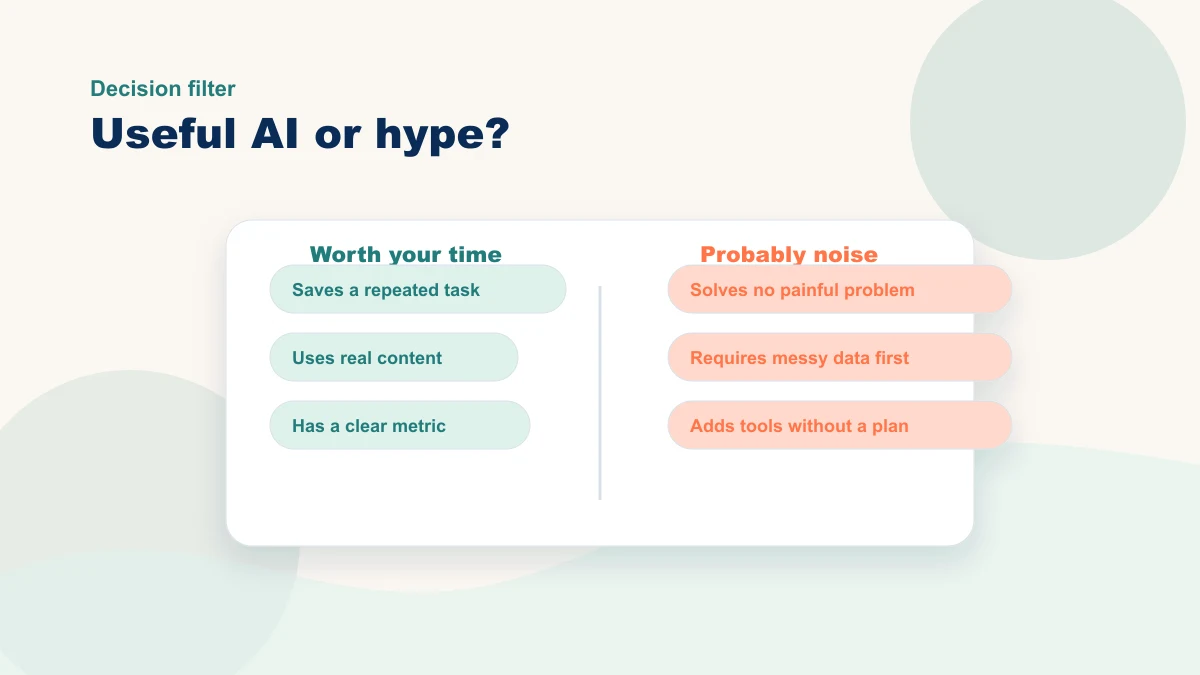
The best thing about simple ROI measurement is that it slows down tool collecting. Once you name the workflow, baseline, cost, and decision metric, you can compare a tool with a concrete need instead of its demo.
Before you buy another subscription, ask:
- Which workflow will this improve?
- What number should move in 30 days?
- Who will own the review?
- What will we stop doing if this works?
- What will we cancel if it does not?
If you cannot answer those questions, pause. The missing piece is not another tool. It is a clearer plan. That is why I usually pair ROI measurement with the same filter I use in AI Tools Are Not the Strategy: outcomes first, tools second.
What to do this week
Pick one AI workflow you are already using or considering. Write down the baseline today. Use it for 30 days. At the end, decide whether to keep, adjust, expand, or stop it.
If the workflow saves time but creates errors, adjust it. If it saves time and the quality holds, keep it. If it creates more work than it removes, stop it without guilt. The point of measuring ROI is not to prove that AI is always useful. The point is to make sure you only keep the AI work that earns its place.
If you want help choosing the workflow, setting a practical metric, or figuring out whether a project is worth the setup time, book a free 15-minute bottleneck review. We can look at one real workflow and decide what ROI should look like before you spend a month guessing.