If AI keeps becoming another distraction, the useful question is not “Which tool?” It is: Which repeated workflow deserves attention, and how will we know whether changing it helped?
A consultant supplies a decision process: map the current work, surface dependencies and risk, compare candidates, define the human handoff, and choose evidence for the next decision. A conversation can clarify the path; implementation and learning still take real work.
What an AI Consultant Actually Does for a Small Business
When I work with a small business owner, the engagement boils down to five things:
- Audit your workflows. We look at how work actually moves and separate repeated preparation from decisions that need people.
- Compare tool fit. Evaluate source control, review, integration, permissions, cost, maintenance, and exit path against the workflow you already run.
- Design one bounded workflow. Define the source, AI-prepared step, human decision, exceptions, fallback, and metric before connecting tools.
- Train around the real handoff. Give the team review rules, examples, escalation steps, and a way to record corrections and adoption.
- Measure the full result. Time, corrections, quality, exceptions, cost, and adoption decide whether the project worked.
That is it. No jargon, no enterprise-style transformation deck. Just a short, focused process designed for a business that does not have a full-time IT department.
Where the Real Time Savings Come From
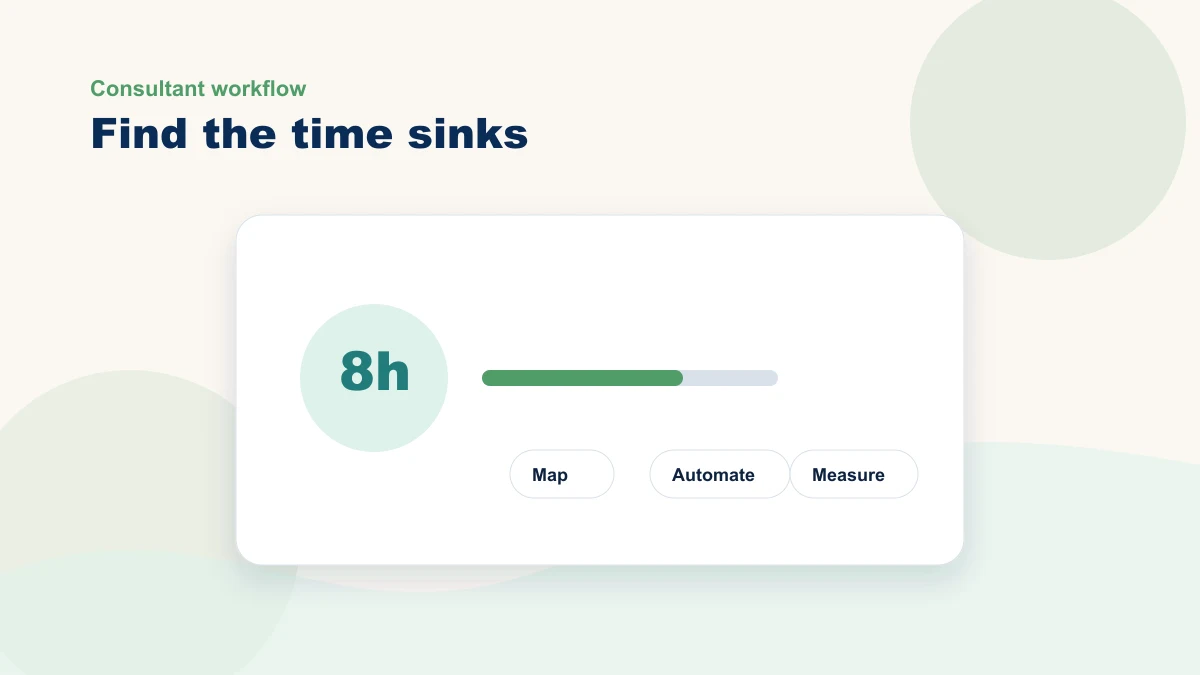
For example, a content audit would baseline source preparation, drafting, fact-checking, voice editing, approval, and publishing. The workflow is worth keeping only if the measured total improves without reducing quality.
The consulting value is not a promise to eliminate dead ends. It is a clearer sequence, explicit assumptions, and early stop conditions so weak ideas are identified before they expand.
A useful consult turns a vague AI idea into a workflow, handoff, risk check, metric, and next decision.
Examples of measurements to establish before implementation:
- Customer email: draft time, review time, corrections, response delay, and escalations.
- Feedback summaries: preparation time, missing themes, false themes, and decisions supported.
- Meeting notes: cleanup time, missed actions, owner review, and follow-through.
Compare the measured value of each workflow with setup, tool, maintenance, and review costs before expanding. The plain-English method is in AI ROI for Small Business.
| Workflow | DIY risk | Consulting shortcut |
|---|---|---|
| Lead replies | Generic templates that do not match the offer | Map inquiry types, draft reusable responses, and define when a human takes over |
| Content repurposing | Lots of output, little publishing consistency | Turn one source asset into a repeatable weekly workflow |
| Admin summaries | Summaries that miss decisions or owner context | Set the format, source inputs, and review habit before automating |
Signs It Is Time to Bring in Help
You may not need a consultant if you have the time, ownership, and risk expertise to run the process. A second opinion becomes useful when:
- You have tried AI tools and they feel like more work than they save.
- You bought subscriptions that nobody on your team is actually using.
- You have a list of AI ideas but no clear sense of which one to start with.
- You know you are wasting hours every week but cannot pinpoint where to cut.
- Your team is skeptical and needs to see one concrete win before they will buy in.
In each of those situations, the bottleneck is not the technology. It is the decision. A short outside conversation breaks the stall.
What a First Conversation Looks Like
A good first call runs 30 to 60 minutes. We talk through:
- The parts of your week that feel like a slog.
- Your team size, technical comfort, and what tools you already use.
- What success looks like 30 and 60 days from now.
- Whether AI is even the right answer for the bottleneck you are describing.
By the end, you should have a first recommendation, its assumptions, a rough roadmap, and a clear decision about what you can run yourself versus what needs implementation help.
What you should expect from any consultant, including me: straight answers about cost, timeline, and what is realistic. No upsells into platforms you do not need. No vendor lock-in. If a consultant is doing anything else, keep looking.
If you want to see how the rest of the engagement unfolds, here is what to expect from a full consultation. If you are still deciding whether the first project is worth outside help, compare your options against the best-first-project criteria. When you are ready, you can review the services I offer or book a free 15-minute bottleneck review and compare one repeated task by frequency, input quality, review risk, and measurable result.