If AI research and demos have not produced a usable next step, the missing piece may be a decision about one real workflow—not more information about tools.
If you have never booked one before, here is what actually happens when we sit down together, what to bring, and what you walk away with. The goal is simple: leave the call with one specific AI project that fits your business right now, and a clear path to make it real.
The Format and How Long It Takes
A consultation with me is usually a 60 to 90 minute video call, or in person if we are nearby. The structure is intentional but the conversation stays flexible. We will cover:
- Your business and what makes it tick
- How your team works and which processes drain the most hours
- What you have tried with AI, and where it stalled
- The bottleneck that bothers you most right now
- What a meaningful win looks like in the next 30 to 60 days
The call is a working review. I ask focused questions, map the current process, compare candidates, and explain the recommendation, assumptions, risks, and next decision in plain language.
What to Have Ready Before the Call
You do not need slides or a written brief. A few minutes of honest reflection on these questions is plenty:
What is your biggest weekly pain point? Which workflow eats the most time or causes the most frustration? Usually it is the task you quietly dread on Monday morning.
How many people are on your team? Solo founder, small crew, or a department-sized operation? This shapes which kind of solution will actually get adopted.
What tools are you already paying for? List the systems involved in the task, who uses them, and what data moves between them. The answer may be to keep, connect, or stop a tool.
What decision must the project support, and when? A 30-day observation window and a 90-day build imply different task volume, dependencies, risk controls, and scope.
That is genuinely all the prep you need. I will guide the rest with follow-up questions.
What We Actually Review During the Call
I will ask you to walk me through your workflows the way they really run today. Where does work come in? How do you handle it? Who touches it? Where does it get stuck? I am listening for the friction points you have stopped noticing because you have lived with them for so long.
If you have already experimented, we will inspect the source, prompt, output, review burden, exceptions, and integration. The issue may be the tool, the workflow design, the input, or the suitability of the task.
We will also trace the relevant customer journey. Where does the task begin, what does the customer expect, who makes the decision, and where does the handoff wait or repeat?
Bring one bottleneck you feel every week, and we will map its source, decision, risk, and next test.
Finally, we will talk about your team and how they actually work. Some teams jump on new tools the day they hear about them. Others need to see a working example before they trust it. The right project for your business depends as much on this as it does on the tech itself, which is why a generic AI guide can only take you so far.
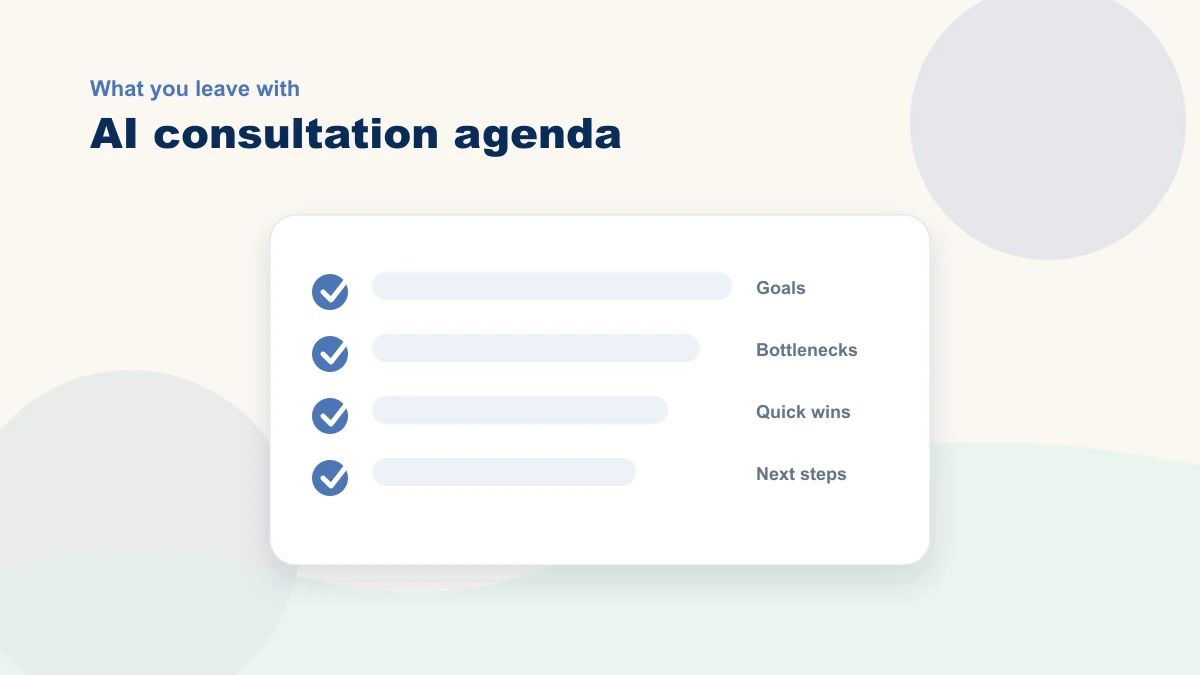
What You Leave With
By the end of our call, you will have three concrete things:
A priority list. Workflow candidates ranked by repeatability, source quality, review ownership, risk, dependencies, and measurement. Some may be marked fix-first or do-not-automate.
Your first decision. A specific recommendation for what to test, what to fix first, or why to wait—plus the tool criteria and unknowns that affect scope.
An owner-readable plan. A short, plain-English document outlining the first project, what success looks like, how to measure it, and what training your team might need. Not a 40-slide deck. Just clarity on what comes next and why.
If you want help executing the plan, I offer ongoing support and we can scope that on the call. If you want to take the plan and run with it on your own, that works too. Either way, you leave with something useful in hand.
What a Simple Plan Might Look Like
A useful plan is short enough to use. For example, a local service business might leave with something like this:
| Week | Action | Success measure |
|---|---|---|
| 1 | Collect the five most common inquiry types and draft reply templates | Owner approves each template once |
| 2 | Use templates for new form submissions with human review | First replies go out within one business hour |
| 3-4 | Adjust wording, add FAQ links, and document the handoff | Team can run the workflow without re-explaining it |
That is the level of detail you want: specific enough to act on, small enough to finish, and measured against one clear result.
What NOT to Expect
Do not expect a generic transformation deck or a predetermined software sale. Expect questions about the real work, explicit tradeoffs, and a recommendation you can evaluate.
You also should not expect the consultation itself to deliver the project. A consultation is direction and design. Implementation is a separate step, whether you do it yourself, hand it to your team, or bring me back in to build it with you.
Do not expect certainty on day one. A first project should test a bounded workflow. The observation window depends on volume, risk, and how many real cases the team needs to learn from.
How to Prepare in 10 Minutes
Write down one sentence: What is the workflow I do every week that I wish would go faster or easier? That is your starting point. Bring it to the call, answer questions honestly, and resist the urge to oversell or undersell the problem. The clearer you are about reality, the more useful the recommendation will be.
The value of the call depends on the decision it improves. Bring a real repeated task, its current burden, and the constraints that could change the recommendation.
If you are ready to name the first bottleneck and decide whether a full consultation fits, book a free 15-minute bottleneck review. Want a little more context first? Take a look at how I work with small businesses, or read why working with a consultant saves time and how to pick your first AI project.