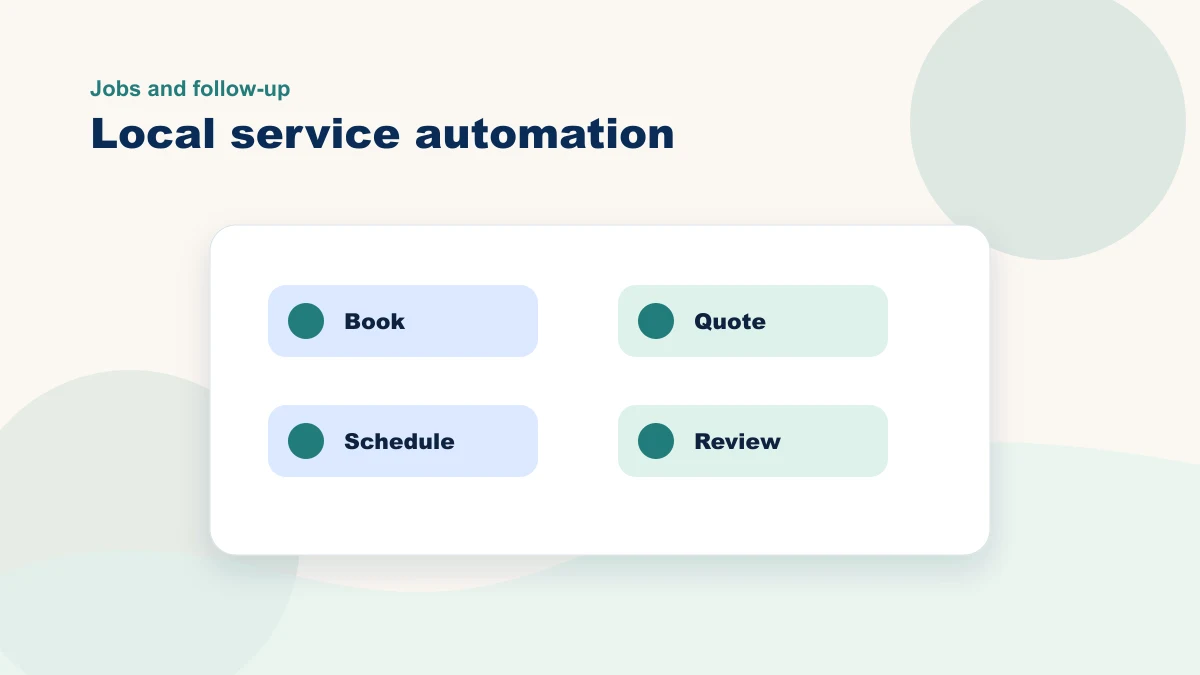
In a cleaning service, landscaping crew, electrical business, or mobile repair shop, inquiries, quotes, follow-ups, and missed calls compete with scheduled field work. The visible problem is not simply speed; it is an undefined handoff between intake, preparation, owner or office review, and the next customer step.
The useful starting point is not “automate the business.” It is one repeated handoff: acknowledge an inquiry, prepare a quote draft, remind a customer, request a review, recover a missed call, or summarize a route. Start with one, measure it, and keep exceptions with a person.
The Six Automations Worth Trying
1. Instant Lead Reply
When a lead texts or emails, a pre-approved acknowledgement can confirm receipt and ask for basic details such as service type, location, and preferred date. A person still reviews the request before promising availability, price, or scope. Measure the gap between inquiry, useful draft, and reviewed reply separately.
2. Auto-Quote Drafts
Your team fills out a short form with job details, and AI prepares an estimate draft from approved pricing rules. A qualified person verifies quantities, exclusions, price, and local requirements before sending. Record current preparation and review time to see whether the draft actually helps.
3. Appointment Reminders
A pre-approved reminder can go out before a service appointment. Track delivery, replies, reschedules, and no-shows; keep a clear route to a person when the customer needs to change something.
4. Review Requests
After a job is marked complete, an approved message can ask for an honest review with a direct link. Measure requests delivered and reviews received without promising ratings, visibility, or leads.
5. Missed-Call Follow-Up
When you cannot pick up on site, a pre-approved text can confirm the missed call and offer a callback or text path. Track how many callers respond and how many receive a reviewed follow-up; do not assume every missed call was a lost lead.
6. Route Summaries
Your team logs notes and photos during the day in a mobile app. AI pulls those notes into a clean end-of-day summary with photos, time on site, and next steps. No more transcribing. No more lost details.
Start with One
You do not need all six. Pick the one with the clearest input, safest handoff, named reviewer, and measurable baseline. Run it long enough to observe real work, then keep, revise, or stop it before adding another workflow.
This slow-and-steady approach matters. Your team learns to work with AI instead of feeling like their workflow got overhauled overnight.
| If you run... | Start with... | Measure... |
|---|---|---|
| HVAC, plumbing, or contracting | Missed-call text-back and estimate draft cleanup | Recovered calls and estimate turnaround time |
| Cleaning, landscaping, or mobile service | Appointment reminders and route summaries | No-show rate and end-of-day admin time |
| Restaurant or hospitality service | Review responses, weekly promos, and schedule drafts | Reviews collected, posts published, and manager hours saved |
Where the Workflow Usually Breaks
The ideas sound simple, but implementation crosses your CRM, scheduling software, phone system, and review platform. The workflow needs one source of truth, a clear owner, and wording that matches what your team can actually deliver.
A workflow review maps the current process, approved language, system handoffs, exceptions, reviewer, and first metric. That gives you a testable design before you connect software or expose customer data.
Common Mistakes to Avoid
A customer-facing draft should not invent warmth, timing, price, or availability. Keep an acknowledgement short, reference only verified information, and state a response window only when the team can meet it. A person still owns the substantive reply.
The other common mistake is setting it and forgetting it. Check your data monthly. Are people replying to your reminders? Are no-shows actually dropping? Are review requests landing? What's not working gets adjusted, not abandoned.
Measure What Matters
Once each automation is live, track these:
- How many leads reply to your instant response vs. no response at all?
- How much time does your team save per week?
- What is your no-show rate before and after reminders?
- How many reviews do you collect monthly with automated requests?
- How many missed calls turned into booked jobs through text follow-up?
These numbers tell you whether your setup paid off — and which automations deserve to grow.
What the first test must prove
Automation earns a place only when the full handoff improves without lowering quality, hiding risk, or adding more correction work.
For local service businesses, that's the real prize. You're already stretched thin. AI handles the stuff that doesn't require your skill or your personality, so you can focus on the work itself and the relationships that keep customers coming back.
If you are not sure which candidate deserves a test, use a workflow review to compare frequency, input quality, review risk, and measurability. We will map how leads move through the business and identify the first bounded handoff. Book a free 15-minute bottleneck review here — or if you'd rather poke around on your own, see how the service is structured, read the trades-specific guide, see the restaurant version, or read more on responding to leads faster.